
|
Solar Cookers for Canning and Preserving
The information on this site is mainly aimed at solar cooking. Due to the fact that some forms of canning can be accomplished through the solar box cooker method we have included some information on the subject.
Yes, it is possible to can and preserve some foods using a solar box cooker.But not all foods can be preserved safely by this method.
* * If you have a large enough parabolic solar cooker you then can use a pressure cooker for canning and bottling all kinds of foods.
It is not recommended ever that you can (preserve) non acidic foods such as meats or most vegetables using the solar box or panel cooker method since these usually have to be preserved and sealed by using a high pressure high heat system in order to kill the botulism bacteria through higher sustained levels of heat and pressure.
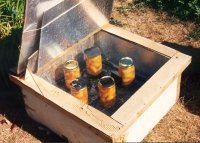
Fruits and tomatoes can be canned though using a solar box cooker, since they are an acidic food. This method though can be a bit challenging since; the conditions required for the preserving and the ultimate results are somewhat difficult to control.There are people who do can (preserve) successfully with this method and it is possible to perfect the process and method, just be aware of the possible outcomes or effects.
It would also be highly recommendable to gain verified and proven information from reputable sources on canning and preserving and to know the rules and the norms for canning in general.
If you do decide to experiment with solar canning please do take all necessary precautions and learn the important facts for proper food safety.
Below are a couple of links on canning basics and safety
* *The following is an excerpt from a page on the www.solarcookers.org website and one lady's personal experiences with solar canning as a method for preserving fruits.
"Almost half of the food produced in the world goes to waste due to lack of a means to preserve it." - Dr. Dieter Seifert
"If I could use my SBC for only one thing, it would be for canning," says Eleanor Shimeall. "Processing in a solar cooker is much simpler than conventional methods. It takes me about 10 minutes of preparation time starting from a bowl of fresh fruit to placing the jar in the cooker. An added bonus is that the benign heat of the sun does not destroy the jewel-like colors of the fruit." Eleanor is such an advocate of solar canning that she has been giving demonstrations in the field without benefit of kitchen facilities. She has also included a chapter on this subject in her book, Eleanor's Solar Cookbook. She says she uses canning jars or jars such as those used by commercially prepared spaghetti sauce, which have a rubber ring bonded into the inside of the screw-on cap. Eleanor uses the "terminal sterilization" method: begin with clean glass jars and lids, add the fruit or tomatoes, dry sugar or salt, and water to fill up to the neck of the jar. You must leave space for expansion of the contents during cooking. Screw lids onto the jars as tightly as you can and place them into the solar cooker. When the contents of the jar boil out from under the lid; the jar and contents are sterilized.
Lids with a rubber ring are made to release steam during canning. Once the correct temperature has been reached, the contents of the jar will boil and flow under the tightly screwed-on lid. Remove the jars one-by-one as each one boils over. Wipe clean, set aside away from drafts to cool down slowly. As the jar cools, the lid is pulled downward to form a vacuum seal. Check each cool jar to make sure it is sealed properly by hitting it with a spoon and listening for a clear ringing note, or gently press down on the lid making sure it doesn't move up and down. If a jar did not seal, add more liquid or another tomato and reprocess. The quality will not be impaired. Solar canning is safe for acid foods only. Acid foods are fruits and tomatoes, or their juice, jams, jellies. DO NOT CAN MEATS OR VEGETABLES IN YOUR SOLAR COOKER!!! Don't even add a sprig of parsley as botulism can grow on any non-acid food!

Return from Solar Cookers for Canning back to Home page
Go to:
Solar Cooking Recipes
Videos of top Solar Ovens
Solar cooking: When is the best time?
Why Solar Cooking
Hay box cooker

©United states Copyright Solar Cooker at Cantinawest
©International Copyright Solar Cooker at Cantinawest
®All rights reserved,reproduction is prohibited without permission
Copyright 2017