
|
Solar Cooking in Winter
Solar Cooking in winter...
When the sun goes south for the winter it takes a little bit of ingenuity and a little bit more time to achieve the solar cooking results one becomes accustomed to during the long, warm days of summer.
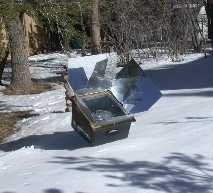
Although most people's minds in the middle of winter are not centered on heat, sunshine, and solar cooking, there are many who do take year around advantage of the opportunity to use their solar ovens to cook a variety of foods ranging from whole turkeys and hams to breads, cakes and casseroles, even on a cold, crisp, sunny winter day. Of course the key to effective solar cooking any time, and in the winter as well, is clear and bright sunshine.
In many areas of the United States, even in the wintry north, there are quite a few sunny days that can be used for solar cooking your afternoon meal.In fact, some areas have brighter sunny days in the winter than they do in the summer due to coastal marine layer or heat induced humidity that creates clouds and haze. See also; Where can you solar cook?
Some points to remember with wintertime solar cooking.
- Outside temperatures are not necessarily a big factor in solar cooker effectiveness, rather the quality and soundness of your solar cooker will more determine your cooking results
- Solar Box cookers are more effective overall in the winter than is a panel cooker due to the ability that a box cooker will usually have to incline the apparatus. A box cooker is also usually more insulated and airtight than a panel cooker, thus allowing for higher overall temperatures than a panel cooker in colder temps.
- The sun "tracks" or moves more quickly across the sky when it is low on the southern horizon, thus necessitating more frequent turning or tracking of the solar cooker.
- In areas with very few hours of winter sun, consider cooking your larger meals in stages, and at times, over more than two or three days when the wintertime sun is not always as abundant.
The most significant factor in your winter time solar cooking will be the amount of sunlight available for cooking, both in length of time as well as quality or intensity of the sun's rays, and the position of the sun in the winter time sky.
For all of us that live above the equator, the lowering of the sun towards the southern horizon during the late fall, winter and early spring months simply means that we need to make some minor adjustments to our solar cookers and the positioning of the ovens.
When the days are shorter and sun is not as abundant; with intermittent cloudiness and sunshine, I have cooked some of my foods and meals more effectively over a longer period of time or in stages; cooking some ingredients one day and finishing other ingredients on another day. If I have little time, but good sunlight, I will start a chili or a roast in one of my solar cookers and let it cook for a couple of hours. I will then put the pot with the partially cooked food into the refrigerator and the next day, conditions permitting, I will put it back out in the solar cooker and finish it up and have it for that day's meal.
Here are a few of my own personal observations and experiences with winter time solar cooking using four solar cookers that we have at our disposal; those being: the Global Sun Oven, The SOS Sport, The Hot Pot (panel cooker) and the Solar Burner Parabolic.
Here in the high desert, many of the days on which I cooked, the temperature was 50 F. or lower; with a few days in the upper thirties, but we have had some unusually cold winters where the temperatures never reached above freezing (32 F) and we have still been able to cook without much problem.
Homemade Solar Oven cooking in Winter
...Which cookers to use for solar cooking in winter?
The Hot Pot is a panel style cooker and requires a little bit of adjustment, enhancing and "jerry rigging" to make it cook more effectively in the winter. The Hot Pot can still be used when the sun is low, but the panels require a different angle than the one customarily used when it is set up for cooking. And the colder weather will sometimes necessitate the additional use of a large oven roasting bag around the glass/steel bowl to help retain more heat.
--I always carry a Hot Pot solar cooker in my vehicle with me and use it mostly to re heat food for my lunches while out on job sites and locations. In the winter the Hot Pot does not cook as rapidly and effectively as when the sun is higher, but I can still heat my food without much problem, it just takes a little longer sometimes and I have to cook more around midday.
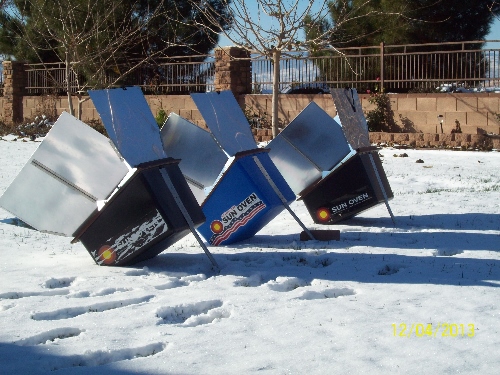
The Sun Oven,the Sport, the Tulsi, SunCook, SunFocus and Copenhagen were designed to compensate for the lower wintertime sun, as opposed to a panel cooker which cannot be inclined very much without tipping the contents of the cooker. I have though used a block or stone underneath my Hot Pot, but it inclines the cooker only so far towards the southern horizon, thus still not attaining enough "direct" rays from the sun to allow for longer periods of cooking.
I am located at about the 35th parallel, in the southern end of the state of Utah, and by the time mid November rolls around, I have to start flipping my Hot Pot Panels onto its side to get a better, more direct sun angle to the pot.
(There are some panel style solar cookers that can be used more effectively because of their design to compensate for the lower sun angles of the wintertime, one of these is the Copenhagen Lite, and another is the SunFlair Solar Cooker that is made to function with lower sun angles as well. These do not have great insulative properties, but they can receive the suns rays efficiently)
As for the Sun Oven, the SunCook and the Sport, I am able to solar cook very well throughout the whole winter with very little problem, barring the lack of sunshine of course.
The Sun Oven should have the inclining leg adjusted to its full extent and length during the shortest days of the winter, which in turn makes it a little bit more prone to breezes and possible tipping, but I just add some stabilization by putting some bricks or wood blocks underneath the raised portion of the bottom of the cooker.
The SOS Sport Oven is built with a 30 degree summer and a 60 degree winter angle, so all you have to do is lay it on it's narrowest side and it will be perfectly angled and inclined to most effectively receive the direct rays of the sun for winter solar cooking. The one drawback to using the wintertime angle in the Sport is that the "floor" space inside the oven cavity is reduced , or narrowed, down, thus necessitating the use of smaller cooking vessels. The round roasters that come with the Sport will not fit inside the oven when being used in the wintertime mode.
I use a small oval shaped chicken roaster in my Sport Oven at this time of the year because it will fit just fine inside of the Sport. The chicken roaster is made of the same materials that the round pots are made of, and I found my roaster at a second hand store.
One Sunday, about a week or two before Christmas, we set out our Sun Oven with a four pound beef roast along with some cubed potatoes, carrots, onions, broth, bouillon and seasoning mix that ended up totaling about nine to ten pounds of food altogether.
We set the food and the Sun Oven out at about 10:30 AM, because that was about as early as we were able to do so, and by 3:00 PM the food was all cooked; nice and moist and tender.
Of course at this time of the year we had to "track" the sun more frequently to keep our temperatures at the optimum levels, but the oven maintained a temperature of 300-350 F the whole time.
Every so often, when I am pressed for time or I lack the sufficient time, I will add on some booster panels to the three of my cookers in order to help speed up the cooking process by augmenting the concentration of the suns rays into the ovens.
At times I use some of the silver reflective coated "bubble" insulating material from our local Home Depot, cut into two foot by two foot squares and clipped/secured onto the already existing aluminum reflector panels of my solar cookers. Doing this will increase the height and width of my panels overall and allow the panels to capture and concentrate more of the suns rays onto the cooker and food. I use these panels both in the summer and wintertime, but more so in the winter.
The SunCook is very well insulated and can retain heat very well in the wintertime.
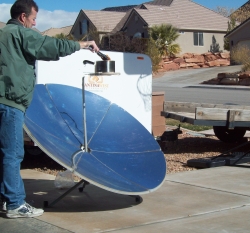
When I use my Solar Burner Parabolic cooker in the winter, there is a need to adjust the cooker a bit more frequently (both the elevation and the left to right trajectory) due to the increased speed of the sun moving across the wintertime horizon. But because the Solar Burner cooks more rapidly, similar to a stovetop, I have most of my cooking finished within a short time and do not have to worry about the need for more hours of sunlight as with a solar oven.
In the winter we have used our parabolic to cook up pots of hot oatmeal and cracked wheat cereal as well as to fry sausages and bacon, boil water for hot chocolate and cider and for frying scones, fish and fry bread.
I will admit that if one wants to use the parabolic for breakfast items, then it would be best to not plan on an early breakfast as one might do in the summer. Most solar cooking in the northern hemisphere in winter will usually not be very productive until around roughly 10:30 AM at the earliest, and one should start progressively later the farther north one lives.
Reheating leftover foods and heating up fast foods (processed foods) is very easy to do in the wintertime since they do not require much more than an hour of time at best to thoroughly heat or cook in a solar box style cooker.
Many times I will arrive home at about eleven in the morning, quickly set up the Sun Oven or Sport Oven, and throw in one of the roaster pots filled with leftover lasagna or chili or even some frozen corndogs, burritos or chicken nuggets and within thirty to sixty minutes, depending on the amount of food, I will have a piping hot lunch by the time twelve o'clock rolls around.
Even in the middle of winter the solar cookers reach 300 F and above, thus enabling me to cook a quick lunch while I am busy doing other things.
At our current home we have a south facing sloped front and side lawn that allows me to place the solar cookers with a slightly deeper angle advantage, and the south side of our house allows for nice, obstruction free solar cooking where I do not have to move the solar cookers or make near as many adjustments to track the cooker towards the sun.
Even though I don't worry about heating up the house like I do in the summer time, I still love winter time solar cooking because it is just as convenient, more economical and as tasty as cooking by conventional methods.
I have had people tell me that they would never have need of a solar cooker for use in the winter where they live because it is too cold and they would also rather cook inside in order to help heat the house against the cold temps. I do understand their thinking, I too want to heat the house in the wintertime with anything that will add extra warmth, even cooking, but I also realize that unless you have a properly vented wood stove to use for heating and cooking (when the electric and gas lines are no longer serviceable...natural disaster) you really cannot cook indoors for added heat with a fuel stove unless you have a means of ventilating your home, which would then cause you draft and cold temperature issues. Gas, sterno, fuel tab, rocket stoves etc. cannot be used inside of an unventilated dwelling due to carbon monoxide poisoning.
This is when a solar cooker would come in handy for cooking, when the sun is shining and you want to also preserve your limited supplies of expendable fuels, even in the cold winter time.
Cooking On a Snowbank
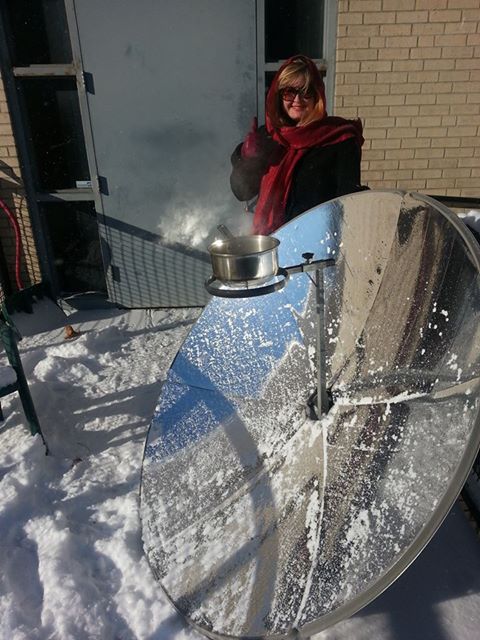
Questions: I
live in upstate NY.
Would I be able to get the oven hot enough to use in my area in the winter?
-Debra
You should have no problems getting your solar oven up to 350 F. in New York, even on a cold winter day.
We had our coldest winter in the last forty years here, -5 below, which is unusual for our area and the day after the (unusual snow storm) I had my three Sun Ovens out cooking without a problem.
You just need a nice sunny day. (even high thin cloudy days you can cook many items)
We have customers all over the New England States and Canada that solar cook in the winter on the sunny days they do have.
If you have not already seen our pages, you might find these helpful:
Also check out our Facebook page for lots of winter, and year round, solar
cooking posts etc.
https://www.facebook.com/pages/Solar-Cooker-at-Cantinawest/107497525996738?sk=wall
Throughout our website you will find lots of helpful information and shared
stories from people all over who solar
cook at all times of the year in all kinds of places around the world.
I hope this is helpful, and if you need to know any more, just let me know.
Sincerely,
Nathan Parry
Receive latest updates to this site without having to subscribe or give your info. You can always know what is new and happening in the world of solar cooking by receiving updates from our site as they happen...
You can do this through your computer using the RSS feed...
Add our feed by clicking on the orange RSS button found on the left side at the top of each page of this site, and you will always find plenty of useful information.
*Note: It is not necessary to submit your email or personal information in order to receive the RSS feed.
Do you have any Great Solar Cooking Tips?
Share with us and others your Tips, Suggestions, Ideas and methods for getting the most out of your solar cookers.
Share the best way to prepare and cook different foods such as...pastas, rice, meats, pastries etc.
Any Challenges with Wintertime Solar Cooking?
How do you brown foods?
How do you avoid over or under cooking rice?
How do you cook corn on the cob? etc.
What Other Solar Cooks Have shared
Click below to see contributions from other visitors to this page...
Does solar oven work in winter? 
I need to do a project on solar oven and its the winter right know! would it work?
__________________________________________
Greetings ??? I didn't …
Return from Solar Cooking in Winter back to: When to Solar Cook
SOLAR COOKER CATEGORIES
Panel Cookers
Box Cookers
Parabolic Cooker
Evacuated Cookers
Accessories
Discontinued CookersNew Financing Options available for purchase of Solar Cookers


©United states Copyright Solar Cooker at Cantinawest
©International Copyright Solar Cooker at Cantinawest
®All rights reserved,reproduction is prohibited without permission
Copyright 2017