
|
Solar Cookers: Varieties and Styles
In reality there are endless varieties and countless styles of solar
cookers that have been made, and are continually being modified around
the world. For our purposes though we will use the three main styles
(classes) that are in use today.
These would be the Box Cooker, Panel Cooker and Parabolic Cooker (concentrator)
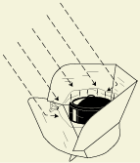
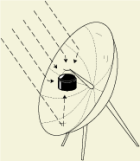
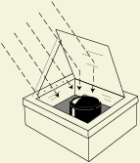
Most all of the solar cookers in the world today fall within these three
categories, with many usually being a combination of the three styles;
for more effective cooking results.
In the past most were
fabricated or constructed by individuals using readily available
materials that were usually acquired at home or the local hardware
store.
Even now, at this time though, many around the world through
necessity, and also as an option, still construct home made solar
cookers and use them with very amazing results.
But because of
the growing awareness of the feasibility of using solar energy for
cooking, and the increased world wide use of solar cookers, some
organizations and businesses have begun to manufacture a variety of
solar cookers, in the various styles and classifications, for sale on
the commercial market and also for charitable donation toward
humanitarian related efforts in economic, climate and war ravaged areas
of the world.
What is your favorite Solar Cooker?
If you would like to share your opinion or thoughts regarding which solar cookers are the best and why...go to the submission form My favorite Solar Cooker
Box Cooker:
The most common and popular
variety is probably the box cooker. Its design is based on the concept of
a traditional modern oven where the food is placed inside of an
insulated box for purposes of retaining or trapping the solar rays that
have been converted to heat energy.
(In order for the solar rays
to covert to heat energy they must be able to reach the cooking utensil
(pot, pan) usually passing through a transparent covering (glass,
plastic) on the box cooker. The solar UV rays are then converted to
longer infrared rays that heat the pot and food. The longer UV rays are
not able to pass back out through the glass (transparent) covering and
are thus retained inside the box enclosure, creating a buildup of
heat; raising the temperature inside to sustainable cooking levels and
thus causing the food to cook.)
A box cooker can be made out of
any type of material such as; wood, plastic, cardboard, etc. Usually two
boxes of varying size are needed in order to be able to fit the smaller
one inside of the larger one, thus creating a gap or space around the
smaller box which can then be filled with paper, hay, fiberglass etc. to
form an insulating barrier between the two boxes to prevent the escape
of heat through conduction. Manufactured boxes are designed and built
with the gap and insulation ready made.
Finally a transparent
cover on top of the box is needed to permit solar rays to enter the box
and at the same time prevent the escape of the (UV) rays that have now
become solar energy (heat).The transparent cover can be created by using
plastic sheets, glass sheets (preferably tempered so as not to break)
or by using oven cooking bags.
Reflector panels are usually added
for purposes of concentrating the suns rays toward the cooking pot and
food for higher cooking temperatures and effectiveness.
These
cookers can typically reach temperatures of 300° F (150° C) which is
plenty hot to cook any food you would like. Food containing larger
quantities of moisture cannot get much hotter than 212° F (100° C) so it
is not necessary to cook at higher temperatures.
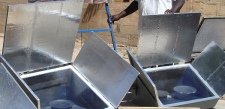
Figure 2 Solar Box Cookers
Panel Cooker:
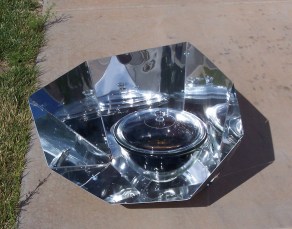
The panel cooker usually consists of a
cooking vessel (pot or pan) which is usually darkened or blackened, an
oven cooking bag or transparent glass bowl along with a reflective
panel. These panels can be made from aluminum foil over corrugated
carton, or from tin or sheet metal panels polished to a high sheen and
also with mirrors.
The oven bag or glass bowl allows the suns UV
rays to penetrate towards the food in turn trapping the energy; (heat)
preventing its escape.
The reflector panels concentrate the sun
light onto the cooking vessel containing the food, in the same way the
panels do so on the solar box cookers. A panel cooker is usually simpler
and more economical to build and results in the same cooking
effectiveness for most all situations. Some panel cookers can achieve
relatively high temperatures depending on the pot and the food being
cooked. Since most foods cooked in these types of cookers usually contain
more moisture (soups, stews, meats etc.) they will usually cook around
225-250° F; similar to a slow, or crock cooker.
Figure 3: Panel cooker with glass bowl and pot
Parabolic Cooker:
Often known as, and called
concentrator cookers, these are usually a bit more complicated to
construct due to the design and necessary materials, but still are quite
common in some areas of the world.
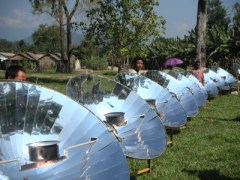
The parabolic cooker can
reach high temperatures more quickly, therefore cooking is accomplished
more rapidly, though more frequent adjustment of the concentrator is
needed for maximum effectiveness.
It is often necessary to use them under the supervision of experienced hands since they can cause harm if used improperly.
Solar Parabolic Trough Cooker
Some parabolic cookers are limited in the quantity of food that is
possible to be cooked at one time since they usually have only one pot
that is suspended in the center of the path of highest solar energy
concentration, but as mentioned earlier they can cook faster.
These cookers have been used on a large institutional scale in China for many years along with a few other countries.
Figure 4 Parabolic cookers in South Asia
Here I show you the manufactured versions of all three types of cookers available from our site and give you a little more information on how they work.
Our colleague in the solar cooking world, Dr. Ashok
Kundapur, from India is a world renowned expert on solar cooking in
general and especially on Solar Cookers. His site has a comprehensive
listing of, and commentary on, the many varied and numerous solar
cookers, solar ovens and solar concentrators. For detailed information
on the best known solar cooker inventors and their products please visit
concentrator cookers and solar box cookers
To learn of the Pros and Cons of each style of solar cooker see our site page solar cookers: pros and cons
See also our Solar Ovens Comparisons page for the top commercial solar cookers.
Here
you can find some information on the development of a cooker that is
very similar to a parabolic cooker but uses the reflective panel
theories for it's design www.earthboundtech.com
Here is a site with some great information on the Worlds Largest Solar Kitchen
Our
colleague and friend Brad Belford of Las Vegas put together a really
comprehensive PDF file of a great deal of useful information, photos,
commentary and analysis on every kind of solar cooker you can imagine.
This is a great file to use for reference Mini Reference Guide to Solar
Cooking
Find out about some of the top, commercially manufactured solar cookers available through the following links
See more details on our full line of solar cookers, get the information to make a more informed decision when purchasing your own solar cooker.
Global Sun Oven
Hot Pot
Solar Burner Parabolic
SOS Sport Solar Oven
SunCook Solar Oven
Sun Chef Cooker Parabolic
Cookup200
Copenhagen Lite Solar Panel Cooker
Solar Flame Parabolic Cooker
SolSource
Pots/Pans for Solar Cookers
Go to:
Build a Pizza Box Solar Oven
Why Solar Cooking?
How Solar Cooking Works
Solar Cooking Tips
Solar cookers: Pros and Cons
Solar Cooking Where
Rate A Solar Cooker: What is your favorite Solar Cooker, and Why?
Which is your favorite and why do you like (it) more than any other?
Do you have more than one... and why?
What Other Visitors Have Shared
Click below to see contributions from other visitors to this page...
Great Solar Cooker Buying Experience 
To all out there,
I'm Alex, I got interested in solar cooking to conserve energy and to also enjoy the sun's energy into my foods I cook. I searched and …
Pizza Box Cooker Not rated yet
It so easy to cook food in it, it was super inexpensive and I made it with just my regular household items so it costed nothing at all!
I have questions about the CKI and the Solar Flame Parabolic Cookers Not rated yet
Hi Nathan,
I'm trying to decide between the Solar Flame and the Steel (CKI). We live in WA State but plan to eventually winter in Tracy CA. We'll want …
SOLAR COOKER CATEGORIES
Panel Cookers
Box Cookers
Parabolic Cooker
Evacuated Cookers
Accessories
Discontinued CookersNew Financing Options available for purchase of Solar Cookers


©United states Copyright Solar Cooker at Cantinawest
©International Copyright Solar Cooker at Cantinawest
®All rights reserved,reproduction is prohibited without permission
Copyright 2017